
Your First Scuba Dive in Albania: What Actually Happens
A clear, realistic guide to trying scuba diving in Saranda, including the difference between an introductory experience and certification.
Julian
PADI Assistant Instructor
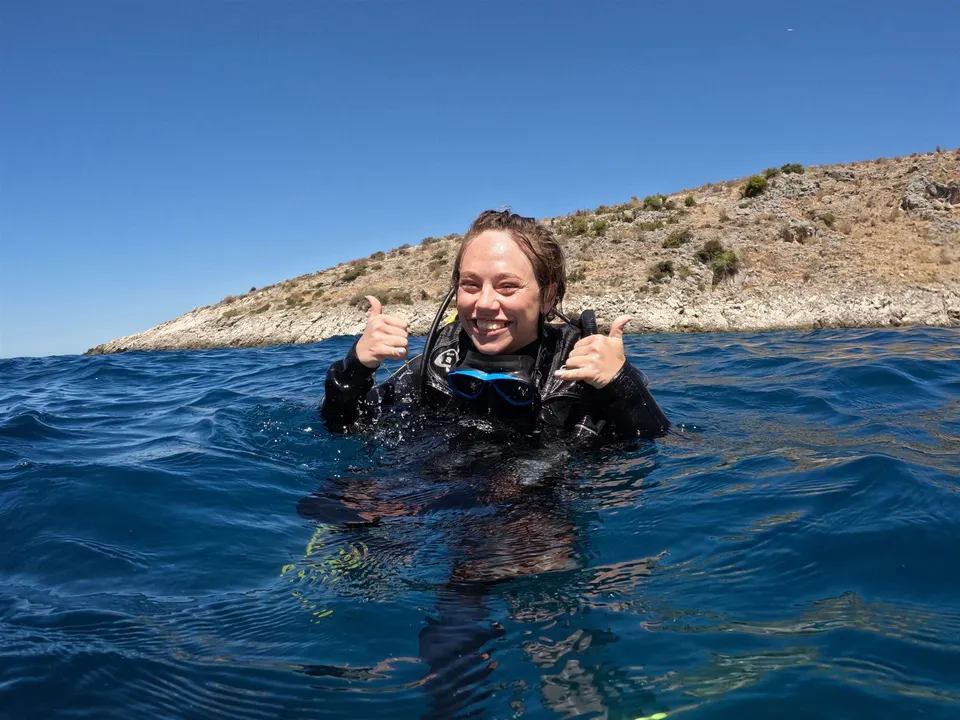
You do not need to arrive in Albania as a certified diver to experience breathing underwater. You do need the correct type of activity, honest medical information and a professional who can slow the session down when something does not feel right.
At our PADI dive center in Saranda, the appropriate programme for a first dive is Discover Scuba Diving. We begin in sheltered shallow sea water before deciding whether you are comfortable continuing with the experience.
Discover Scuba Diving is not a certification
This distinction matters. Discover Scuba Diving is a supervised introductory experience. Completing it does not give you an Open Water Diver certification or permission to book independent certified-diver trips elsewhere. The PADI Open Water Diver course includes knowledge development, confined-water skills and open-water training, and successful completion leads to certification.
An introductory experience can help you decide whether you enjoy scuba and want to train further. It should never be advertised as a shortcut to a certification card.
Step 1: honest registration and medical screening
We need accurate contact, age and health information before accepting a diver. Some answers require review by a physician before diving. This is not a judgement about fitness in daily life; pressure changes and breathing compressed gas create specific considerations.
Read every question rather than clicking quickly through the form. If our booking system stops the request and asks for a medical certificate, no online booking has been created. Contact our team so we can explain which document is needed and whether a manual booking can be considered.
Step 2: equipment and briefing
The instructor explains the purpose of the mask, regulator, buoyancy device, weights, cylinder and gauges. You learn the hand signals needed to communicate, how to equalise pressure in your ears and what to do if water enters the mask or the regulator is briefly out of your mouth.
Ask questions at this stage. There is no reward for pretending to understand. A useful briefing should also tell you where you will enter, the maximum depth, how the instructor will position the group and how the session ends.
Step 3: first breaths in shallow water
Your first task is simply to breathe slowly and continuously while your face is in the water. The instructor then practises a small set of essential skills with you in water shallow enough to pause comfortably.
Ear pressure should be equalised early and often. If an ear does not clear, signal the instructor, move slightly shallower and try again gently. Never force equalisation or continue descending through pain.
Step 4: the supervised dive
When the instructor is satisfied that you are comfortable, the experience can continue into the planned open-water section. The pace should be slow. Your job is to breathe, look around, stay close and communicate. The instructor manages the route and helps with buoyancy and position.
Seeing more animals or reaching a particular depth is not the goal. A calm ten minutes in which you feel in control can be a better first dive than a longer session spent fighting discomfort.
What should you bring?
- Swimwear and a towel.
- Drinking water.
- Any medical certificate requested during registration.
- Enough time to arrive without rushing.
The required scuba equipment is included in our introductory experience.
Common worries
I feel nervous
Nervousness is common and useful to mention. It lets the instructor adjust the pace and keep the first practice simple.
I am not a strong swimmer
Tell the centre before booking. Comfort in water and programme requirements still matter, even though scuba equipment provides buoyancy. The staff must decide whether the activity is appropriate.
My ears will not equalise
Do not descend through pain. Stop, signal and move shallower. If you cannot equalise comfortably, ending the dive is the correct decision.
Can I fly after the dive?
Do not schedule flying immediately after scuba. Divers Alert Network recommends at least 12 hours before flying after one no-decompression dive and at least 18 hours after repetitive or multi-day no-decompression diving. Tell our team if your travel plan is close to these minimums.
What comes next?
If you enjoyed the experience and want to become a diver, ask about the PADI Open Water Diver course. Choose dates that allow you to complete the academic, confined-water and open-water requirements without squeezing them between flights and other tours.
A good first dive should leave you informed, comfortable and curious. It does not need exaggerated promises. Clear expectations, careful screening and patient instruction are what make the experience worth remembering.
Sources checked
PADI Discover Scuba Diving course information